The post Ladyfinger Strawberry Cheesecake Easy Recipe appeared first on The World Is an Oyster.
]]>No-Bake Summer Fruit Cheesecake
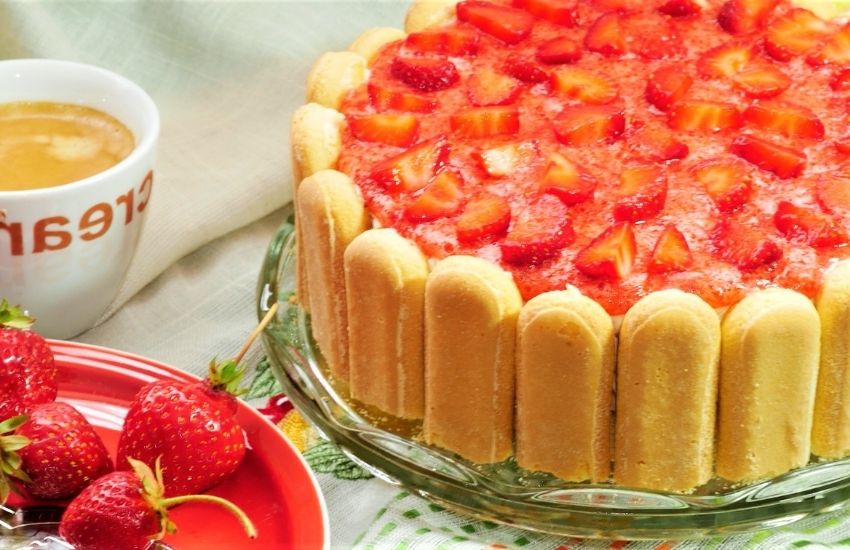
Ladyfinger strawberry cheesecake is the easiest and quickest no-bake cake to make with fresh fruits in season.
This post may contain affiliate links, which means I will receive a commission if you purchase through my links at no extra cost to you. Please read the full disclosure for more information. Thank you!
Historically, the Greeks baked cheesecake millennia before New York made famous the non-bake version. Although I am a history buff, I have catalogued this recipe as Italian because the cheeses and biscuits I used were Italian.
A quick Google search will indicate that using ladyfinger biscuits in baking is considered artistry and an elaborate delicacy. That is perhaps due to the one-thousand-year history of these tiny, delicate biscuits and their use in the European royal courts.
I use Savoiardi for this strawberry cheesecake because I love the cheese but hate the traditional base of this cake. The combination of crumbled biscuits drenched in fatty butter and sugar made me gag the first and only time I tried it. Then, I would eat like a fussy toddler the rest of the time, scraping the cheese and leaving the crusty base in a mess on the plate. Not very lady-like. Not even adult-like!
I have tried many other combinations for the base, like bran and butter (although bran is healthy, it can irritate the stomach lining; besides, there was the butter thing again – not much difference to me!).
Graham crackers did not work for me either, nor did a pistachio crust, as they still needed a glueing agent, and the only one I could think of was still butter.
Savoiardi were the best option for which I settled in the end. They are not too sweet (I always scrape the excess sugar coating); they are fluffy and airy and absorb humidity well, making cutting the cake easier.
Besides, they look impressive, delicate (the name says it all!) and fancy. It is reason enough to use it in the simplest of cakes and still make it look imperial!
For as impressive as it looks, the biscuity base and wall are not the main star of this recipe. Instead, the cheese in combination with fresh strawberries is!
Typically, I use Ricotta and Mascarpone in equal parts. Compared to butter which contains about 80% fats, Mascarpone, although a fat creamy cheese, has approximately half the fats in butter and Ricotta, only about 13%. This makes it bearable to me and reasonably fatty, although it still is a very rich cake; perhaps this is why my body cannot take the extra that would make the base and walls for it.
In addition to cheese, I use reduced organic coconut sugar. I usually grind it to make it a hue lighter to help keep the cheese as close to its natural colour as possible.
For flavour, any essence would work. My favourite combinations are either lemon, orange or rum. Of course, if no kids are involved in sampling, a couple of alcohol tablespoons won’t hurt; the best are creamy liquors, but it will add to the humidity of the cheese, so there has to be a fine balance if used.
Hardening the cheese has proved quite a task for me. I had many tries until I got the right consistency.
At first, I did not want to use any gelatine to glue the cheese – needless to say, it did not work!
Then I tried vegetable gelatine – it takes too long to set. Besides, the instructions on the sachet were rubbish. I had to make it a few times with different quantities of water (a lot less than instructed), and even so, it just did not work.
In the end, I used pork gelatine sheets, and it did the trick. I had this crazy idea in my head that it was nonsense to use pork in cake, but it is not really like that, and I don’t make this cheesecake that often anyway; I can ignore the weirdness of pork and cake together!
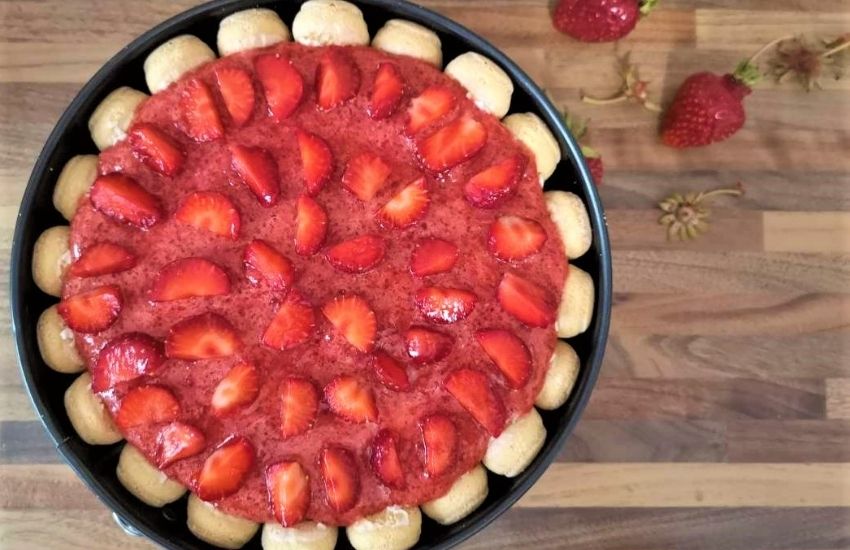
The real star of this cheesecake is, of course, the strawberries – a beautiful fruit that makes the fanciest desserts in summer, such as chocolate-dipped strawberries or chocolate cake decorated with oh, so indulgent chocolate-dipped fruits.
Sweet, juicy, aromatic – just goodness nature selflessly offers us. I always use organic strawberries freshly picked from my allotment.
Conventional strawberries contain over 20 pesticides. Of course, that makes any crop bug-free, helps the fruits grow faster, and produces more money to sustain the greed machine, but what good does that to the human body?
I read somewhere that organic strawberries contain pesticides, too. That defies the meaning of organic and if it is true, I assume it might apply to larger growers or be down to contamination from nearby conventional plots.
I never spray or use anything other than rainwater and fountain water on my plot. If that contains pesticides, it’s out of my hand!
This ladyfinger strawberry cheesecake requires only a handful of ingredients, about half an hour to put them together, and a little patience to allow chilling before enjoying it with a cappuccino or a glass of liquor.
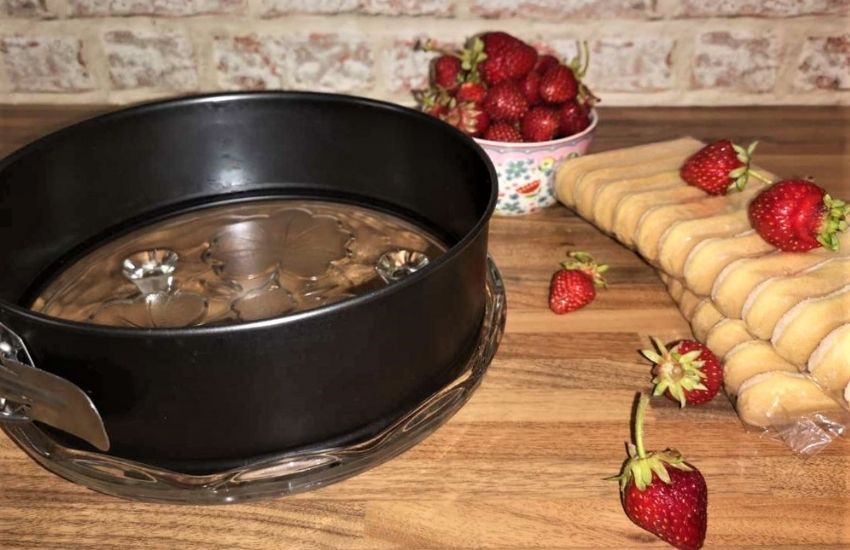
Ingredients for ladyfinger cheesecake
Mascarpone cheese (fridge cold)
Ricotta cheese (fridge cold)
Organic coconut sugar
Ladyfingers (Savoiardi)
Essences as desired
Gelatine sheets
Strawberries
Cream liquor (optional)
Method
Wash and hull the strawberries. Chop them in quarters (or smaller if required). Optionally, sprinkle with the juice of half a lemon to preserve the freshness and colour (it will not change much anyway, because of the immediate use)
Mash a handful of strawberries and leave them aside.
Hydrate four gelatine sheets for five minutes. When the time is up, drain and remove excess water, then place them in a pan in 100 ml water, on low heat. Stir until the gelatine melts, but do not allow the water to boil. When the gelatine has dissolved, then remove it from the heat and leave it aside.
In a large bowl, mix using an electric mixer at medium speed the cheese, grounded sugar, essences (and no more than two tablespoons of liquor if chosen). Batter for about five minutes until you obtain a fluffy cream.
Optionally, you can add some of the chopped strawberries and mix gently with a large spoon.
Add half of the gelatine to the cream, mix well and leave the cheese cream aside until you build the base and walls of the cake.
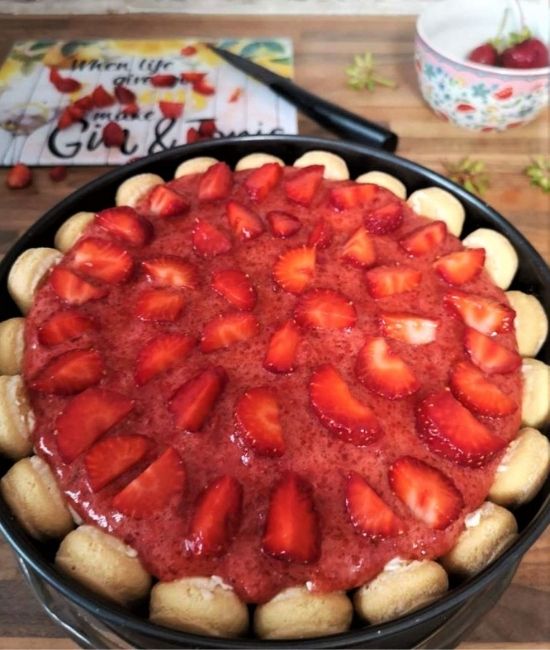
Using only the wall of a springform placed on a cake stand, line it with ladyfingers. If the biscuits are too high, you might need to cut off a quarter or third of each. Then, use the leftovers to line the base.
If you have extra hands willing to help during this step, use them as the ladyfingers have a mind of their own and can make your task difficult.
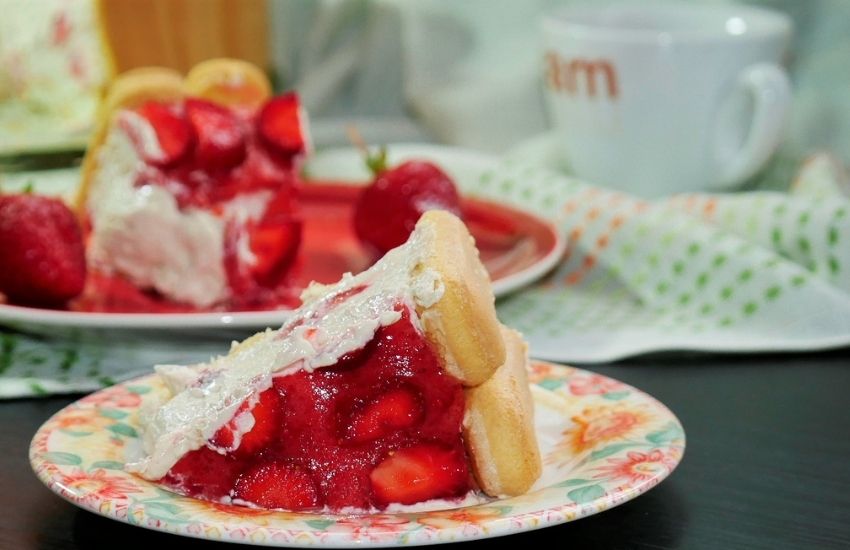
As a tip, I usually fill the base and place a few biscuits on the wall; then, I add a couple of spoons of cream to keep them in place until I continue building the rest of the wall. The base should be covered as much as possible, and there should not be significant gaps in the wall either. The cheese cream is quite thick, but still, for the aesthetics of the final product, take extra care to avoid some of it escaping through the biscuits.
Use all the cheese mixture to fill the shape and flatten it nicely at the top.
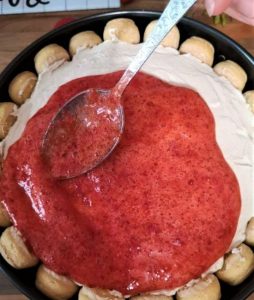
Mix the mashed strawberries with the rest of the gelatine and spread it over the cheese cream.
Some bakers prefer to boil the mashed fruit and add sugar, as in a jam. I just used the strawberries with no added sugar at all, and the taste was excellent – the real, natural thing, since gelatine is tasteless (thank God, it is processed enough not to have a pork flavour!)
Sprinkle the rest of the chopped strawberries over the gelatine mixture, and your ladyfinger cheesecake is ready to go to the fridge for at least three hours. The ladyfingers will get moist even better, and the cake will be easier to slice if you leave it in the refrigerator overnight.
If somehow you manage not to devour it in one go (and you probably won’t because it is pretty rich), you can keep the ladyfinger strawberry cheesecake in the fridge for up to three days. However, I do not recommend freezing as the types of cheese used might go funny when defrosted.
This beautiful ladyfinger strawberry cheesecake is a fresh cake made with fresh products, and it is best to eat it fresh.
I usually make ladyfinger strawberry cheesecake when I have guests. Thus, I know I will not need to worry about preserving it for too long!
Enjoy your delectable, elaborate delicacy!



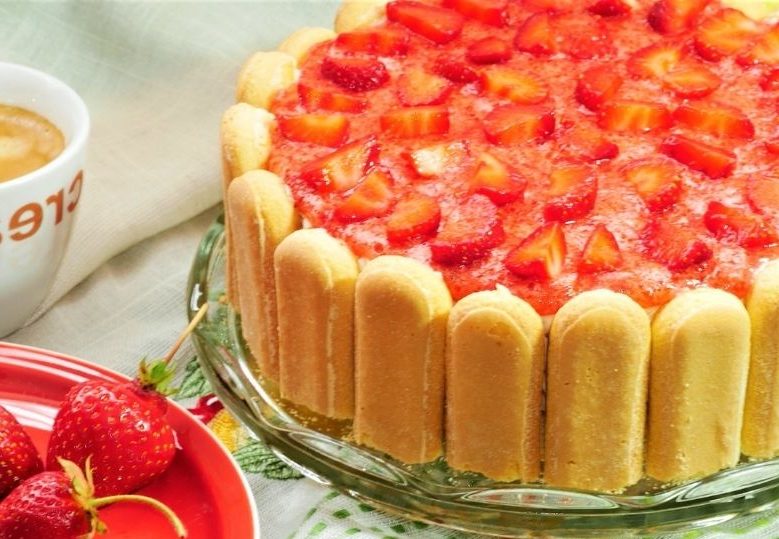
Strawberry Ladyfinger Cheesecake
Equipment
- Mixing bowl
- Electric mixer
- Cake stand
- Round spring form (wall only)
- large mixing spoon
- Measuring spoon/scale
Ingredients
- 2 pcs Mascarpone cheese 250g each
- 2 pcs Ricotta cheese 250g each
- 20 pcs Savoiardi biscuits/Ladyfingers
- 4 gelatin sheets
- 200 g strawberries
- 4-5 tbsp coconut sugar organic
- 2 tbsp cream liquor optional
- 1 tsp rum/orange essence optional
Instructions
- Wash, hull the strawberries and chop them in quarters or smaller pieces.
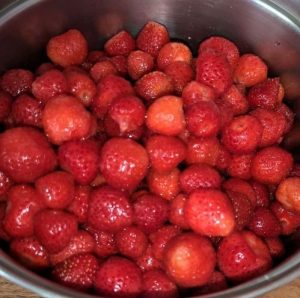
- In a small bowl, mash a handful of strawberries and leave them aside.
- Hydrate 4 gelatine sheets for 5 minutes. When the time is up, drain and remove excess water, then place them in a pan in 100 ml water, on low heat.
- Stir until the gelatine melts, but do not allow the water to boil. When the gelatine has dissolved, remove it from the heat and leave it aside.
- In a large bowl, mix using an electric mixer at medium speed the cheese, grounded sugar, essences (and no more than two tablespoons of liquor if chosen).
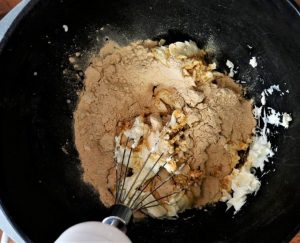
- Batter for about five minutes until you obtain a fluffy cream.
- If you wish, you can add some of the chopped strawberries and mix gently with a large spoon.
- Add half of the gelatine to the cream, mix well and leave the cheese cream aside until you build the base and walls of the cake.
- Using only the wall of a springform placed on a cake stand, line it with ladyfingers. If the biscuits are too high, you might need to cut off a quarter or third of each. Then, use the leftovers to line the base.
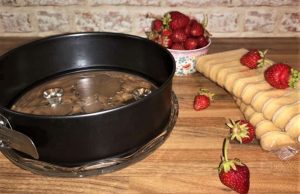
- Use all the cheese mixture to fill the shape and flatten it nicely at the top.
- Spread evenly the mashed fruits combined with gelatine on top of the cheese mixture.
- Sprinkle the rest of the chopped strawberries for decoration.
- Chill in the fridge for at least three hours.
Notes
Do you use ladyfingers for your cheesecakes? What other bases did you try that is not sickly fatty and sweet? I would like to know what different non-squeamish variations people figured out.
The post Ladyfinger Strawberry Cheesecake Easy Recipe appeared first on The World Is an Oyster.
]]>The post Greek Pita Bread. Bake The Fun And Easy Way! appeared first on The World Is an Oyster.
]]>Baked Greek Pita Bread
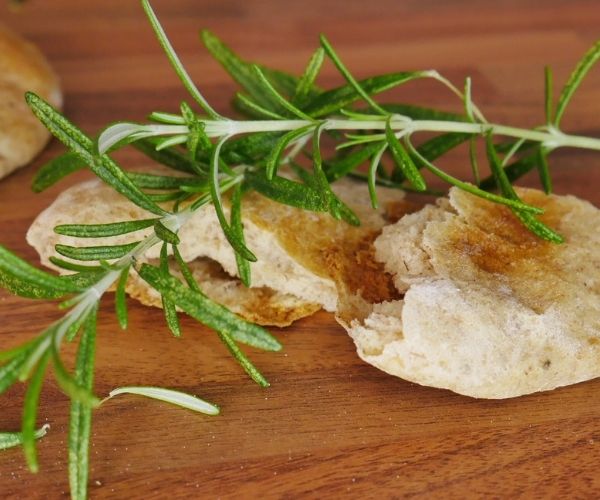
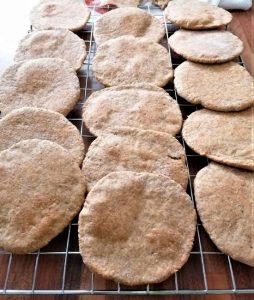
There is no more straightforward recipe to bake nor yummier than pita bread! With origins going back to the Middle East’s first farming settlements, pita can be considered a prehistoric bread type.
Our ancestors used to bake this flatbread directly on the fire. Later, the stone ovens came into use. Today, we bake it in the oven or fry it in little oil, depending on how much time and effort we invest into preparing pitas.
In time, the method has changed, as has the name. Apparently, as its use spread through the Mediterranean, it became pizza in Italy.
I always associate pita with Greek meals, perhaps because I always had it on the table with any meal I ordered in my travels to the fabulous country of ancient mythology. I had it with moussaka and hummus, Greek salad and tzatziki, baked peppers, and you name it! It goes with everything, from appetisers to mains.
At our house, we bake pitta bread nearly every other weekend. I get a hand from a very enthusiastic little helper who is the main beneficiary of the product as well, in the form of school box sandwiches. Sliced bread is so out of fashion; it does not even have pockets! Good enough rationale to get us boxing the dough!
The truth is, pita is so yummy, easy and fun to make and versatile that it would be a shame not to bake it at home. Besides, it is much better than the packed pittas you can buy in supermarkets since you know exactly what you used to make it.
Before you get started, a few facts about flour:
- Humans have milled it for tens of thousands of years.
- The oldest type of wheat is einkorn (“single grain” in German)
- It is NOT white; the flour goes through a bleaching process (with chlorine gas or benzoyl peroxide) to become white.
- It is high in carbohydrates (approximately 76g/100g flour), therefore a no-no for Keto diets.
- The main difference between refined and unrefined grains is that the more flour is processed, the easier it is metabolised into glucose in your body, meaning it transforms in sugar (blood sugar).
- Hemp flour is the lowest in carbs (1.4g/100g) and highest in fibres (47g/100g), pumpkin seed flour is the highest in proteins (54g/100g) but also the most caloric flour (427kcal/100g).
- Almond or coconut flour are great healthy substitutes in baking. Still, they are highly absorbent, so you will need to adjust the quantities of liquid ingredients and also the raising agents you use in the recipe.
Ingredients for Greek pita bread:
Flour (I mix organic spelt and white in equal quantities)
Tepid water
Dried yeast
Olive oil
A pinch of salt
I like to keep things healthy, so I do not add any sugar at all, even though some prefer it.
Optional:
Finely chopped rosemary
Chia seeds
Honestly, I stopped following the quantities long ago. With time and practice, you will know what consistency you need for the dough and add the ingredients as you need them.
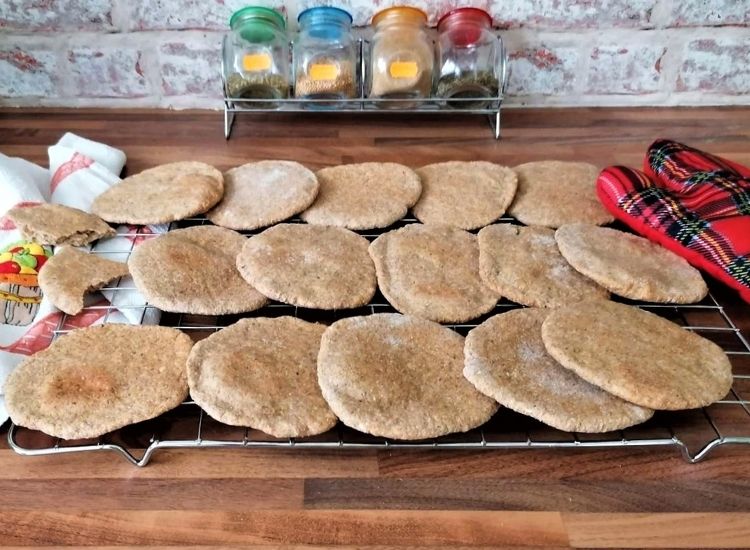
Instructions:
First, prepare a pre-dough – similar to biga for Italian ciabatta. Mix the yeast with some white flour, add the tepid water and let it rest for about half an hour until it raises.
Next, add the rest of the flour, salt and oil (plus the optionals) and mix well. The dough will be sticky, but resist adding too much flour to manage it easier. It is better to oil your hands instead and keep the dough soft and elastic. Let it rise again for another half an hour to an hour.
Preheat the oven at 190-200°C.
Place baking paper on the tray(s).
Spread some white flour onto the working top and divide the dough into small spheres. Usually, I get about twelve pitas using the quantities above. This can and will vary, depending on how big or small you want them.
Using a floured roller pin, make round (-ish) forms of each dough ball, about half a centimetre thick. They will rise at a high temperature and form a pocket that makes pita bread perfect for filling with whatever you desire and making sandwiches.
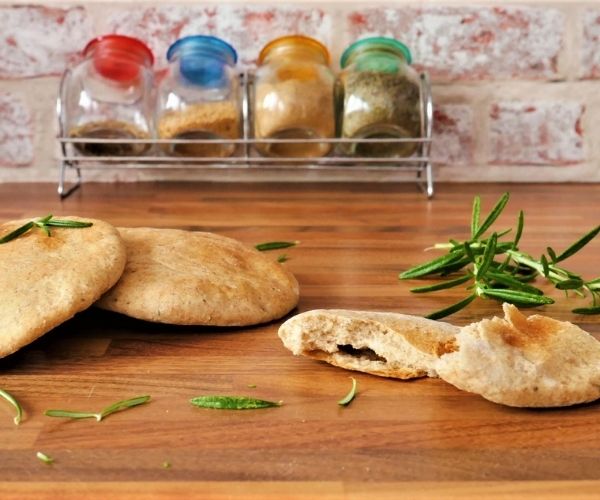
Place the pitas distanced on the tray and bake for about ten minutes. Pita bread bakes quickly and at high temperature; watch they don’t burn!
If the colour changes slightly (it does not have to become dark brown!), it means they should be ready. You can break one to check, but have mercy on your fingers and not injure yourself!
Let the pitas cool before use.
Our first tray always disappears miraculously the minute the pitas cool a little, even if the intention is to freeze them for future use.
Frozen, they last for two to three months, if they last this long (it does not happen at our house!)
Any leftovers? Here are plenty of ideas for how to make good use of them.
I hope you enjoyed reading; now it’s time to start baking your Greek pita bread!
Bon appetite!


Pita Bread
Ingredients
- 250 g white flour
- 250 g spelt flour
- 300 ml water tepid
- 2 tsp dried yeast
- 3 tbsp olive oil extra virgin
- a pinch of salt (rock/sea)
- 1 tbsp chia seeds optional
- 1 tbsp chopped rosemary optional
Instructions
- Mix the dried yeast with some white flour, add the tepid water and let it rest for about half an hour until it raises.
- Add the rest of the flour, salt, oil and the optionals and mix well. The dough will be sticky, but resist adding too much flour to manage it easier. It is better to oil your hands instead and keep the dough soft and elastic.
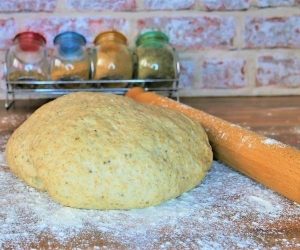
- Let the dough rest again for another half an hour to an hour.
- Preheat the oven to 190°C/374°F/gas mark 5. Place parchment paper on a baking tray.
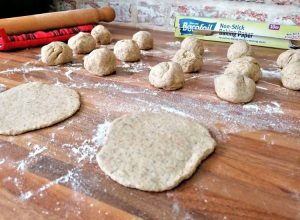
- When the dough has raised, spread some white flour on the worktop and divide the dough into small spheres.
- Flour the roller pin and flatten the balls into 1 cm thick round shapes. The pitas will raise at high temperature forming a pocket that makes them perfect for filling with whatever you desire and making sandwiches.
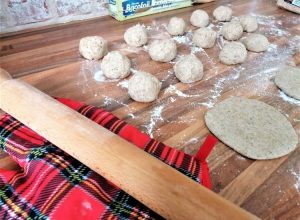
- Place the pitas distanced on the tray and bake for about ten minutes. I usually bake two trays.
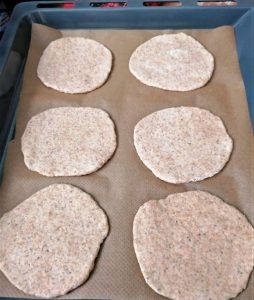
- Pitas bake quickly and at high temperature, so you will have to keep an eye on them to avoid burning. If the colour changes slightly (it does not have to become dark brown!), it means they should be ready.
- Cool before use.
Notes
I hope you enjoyed this recipe. Please share the love by saving it to your baking boards; it will help this blog grow and post more yummy recipes for you to try. Thank you!
Baked Greek Pita Bread
The post Greek Pita Bread. Bake The Fun And Easy Way! appeared first on The World Is an Oyster.
]]>The post How to Make Light Greek Moussaka appeared first on The World Is an Oyster.
]]>A Greek Dish With International Influences
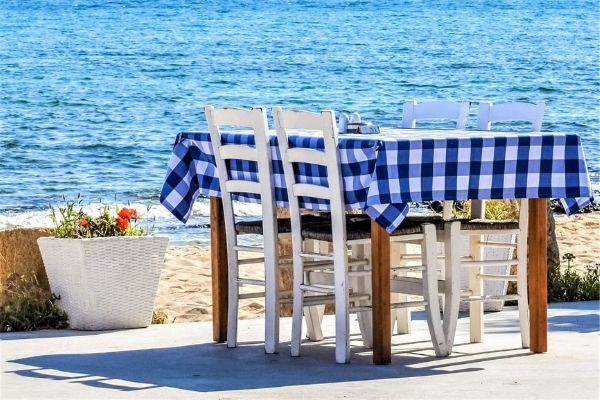
Greek moussaka (or light Greek moussaka for those who don’t care about the heavy béchamel sauce) is a must-have dish if you travel to Greece, just as it is proper to try Greek coffee or wine. The flavours are unique!
As you sit on a tavern terrace and (preferably) enjoy a fabulous sea view, remember that the stress is on the last syllable when you ask the waiter for moussaka.
Original from the Levant and updated by adding a posh French sauce, moussaka is known as a Greek dish, cooked with variations in most south-eastern Mediterranean and not only. Romanians and Bulgarian also love it.
My recipe of light Greek moussaka is somehow altered, due to health factors. Because time is also an issue for multitasking people, I always chose the least time-consuming method; therefore, the recipe might differ from the original. The taste is still excellent, though!
I like to keep cooking fun but rapid and straightforward. First of all, my moussaka will not contain the famous béchamel sauce. It might sound fancy and add flavour to the dish but, to me, is merely a calorie bomb!
After all, the primary role of the béchamel is to help set the meat layer (it is, in essence, a glue sauce, with origins in medieval Tuscany) and confer superior aesthetics to the finished product.
If you are not concerned about your cholesterol level and want to try it, I will explain later how to make the sauce. I did make the original recipe a few times for others; nobody complained about it, on the contrary!
Now that I have all the Greeks against me, it won’t make any difference to tell you that a bit of Parmesan cheese grated on top during the last minutes of baking will give a lovely flavour to the dish. On occasions, when I did not have hard cheese in the fridge, I just grated some Cheddar and let it melt and bake a little. I did say this dish has international influences!
If for any health reasons, or if you are lactose intolerant and prefer dishes low in fats, remember that the flavour is in the spices, not necessarily in heavy sauces or cheeses.
Speaking about spices, a Greek friend of mine once told me that beef must be the only type of meat in moussaka, and oregano the only other seasoning alongside salt, pepper and nutmeg.
I like a dash of cinnamon and always use thyme in mince meats. But I won’t dare upset the Greeks any farther than this! Though, maybe, just a tiny bit of ground coriander, perhaps?
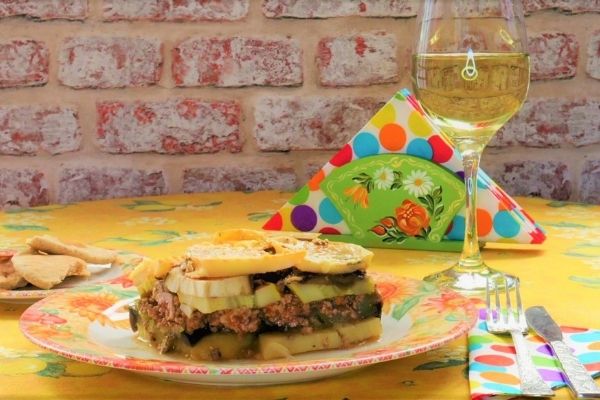
Ingredients for Light Greek Moussaka:
2.5 kg of potatoes (have a few spare ones, in case you remain with an incomplete layer)
800 g (lean) minced beef
Two large onions
One pepper (I prefer the taste of pointed peppers)
Four large tomatoes (or a tin of chopped tomatoes)
Two large aubergines
Three courgettes
Six garlic cloves
Spices: dry oregano, thyme, salt, pepper, freshly grated nutmeg (optional: cinnamon and ground coriander)
Optional – Ingredients for Béchamel Sauce:
1l full-fat milk
100 g butter
100 g plain flour
100 g grated Parmesan or any other hard cheese
Two egg yolks (for colour)
Spices: a tiny pinch of salt (the cheese is salty enough), white ground pepper, freshly grated nutmeg
How to Make Light Greek Moussaka:
Preheat the oven (180°C/350°F).
I always start by preparing the meat. I usually buy two packs of organic lean minced beef. Even the lean meat will have some fats in it, so I do not add any oil. Believe me when I say that your liver will thank you for not caramelizing the onions in oil!
Place the mince in a large pan over medium heat, add a large glass of wine, the finely chopped onions, pepper and tomatoes and stir. Cook it for about ten minutes, stirring occasionally.

When is nearly ready, add the chopped garlic. I always cut garlic with a ceramic knife because stainless steel can oxidise it. Sprinkle the spices, stir for 3-5 minutes, then turn the heat off.
For the veggies, you have three options: fry them in oil (they will absorb it like a sponge!), bake them in the oven for 15-20 minutes, or use them raw.
I prefer the latter option (the other two are either too unhealthy for my taste or time consuming). The result is the same; the heat in the baking phase is enough to cook everything evenly.
Regardless of your chosen method, cut the potatoes, aubergines and courgettes into no thicker than one cm slices.
Perhaps it is a good idea to start with the potatoes and soak them in cold water for a few minutes until you cut the other veggies (to get rid of the excess starch).
In a large baking tray, start with a layer of potatoes (sprinkle a little salt and dried oregano). Continue with a layer of aubergines and courgette (slightly salted).
The next layer is the prepared meat (add half of the béchamel sauce and mix well if you decided to go for it).
Continue with another layer of courgette, aubergines and potatoes, slightly salted. Sprinkle a little dried oregano over the potato slices.

To avoid burning the potatoes, I usually spread a couple of tomato sauce spoonfuls over the last layer before baking. If you made your béchamel sauce, lay the remains of it evenly over the entire surface.
The tray is ready to go in the heated oven for about 50-55 minutes (a little longer for raw veggies – test them with a fork, you’ll know when they are done), at medium temperature (180°C should do).
Just before the time is up, grate some hard cheese on top and bake the moussaka until the cheese starts bubbling.
Let the moussaka cool before you cut it; otherwise, the non-béchamel version can be a bit challenging to place on a plate in one piece (it will not be as glued).
This is a recipe for eight portions because moussaka is a dish that can be stored in the fridge for two to three days or frozen (for a maximum of three months). Of course, fresh is tastier; this is why I make sure to cook it close to mealtime. On the subsequent days, you will have to reheat it before serving.
Light Greek Moussaka goes well served with a Greek salad or a simple salad and pita bread.
Enjoy it with a glass of chilled Retsina, my favourite Greek wine!
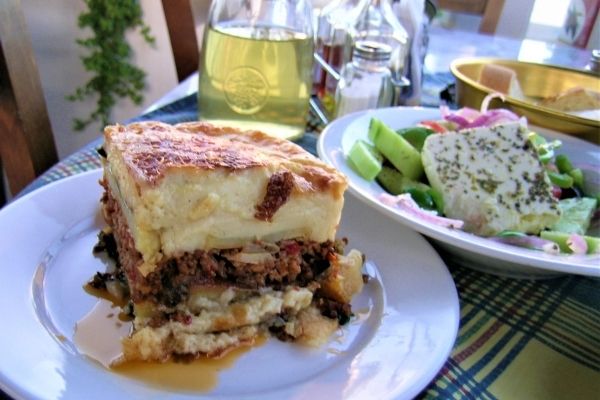
How to Make the Béchamel Sauce:
If light Greek moussaka won’t do for you and you want to try the full-fat version, add béchamel sauce. I promised I would explain how to prepare it, so here it is!
The famous béchamel sauce, originally a salsa colla (Italian for glue sauce), has allegedly been imported by Caterina de Medici, an ambitious Italian noblewoman, to France when she married King Henry II. A couple of centuries later, a marquis in the service of King Louis XIV, called Louis de Béchameil, improved and renamed the sauce after his name and this is how we know it today.
The first step in preparing this sauce is to warm the milk in a pan over medium heat. The milk should not boil, but it has to be quite hot.
In another saucepan, melt the butter without boiling it, over low heat. To add the flour, remove the pan from the heat and pour the flour while whisking vigorously with a stainless-steel whisker. It might look lumpy at first, but continue mixing and the lumps should dissolve.
Return the pan to low heat and gradually add the hot milk, whisking continuously. Add the spices (salt, white pepper, freshly ground nutmeg) and stir continuously for about five minutes or until the sauce starts bubbling.

Remove from the heat to add the egg yolks (one at a time), stirring well. Return to the heat for another minute, stirring continuously. Add the cheese and whisk for another minute or two.
Turn the heat off. The sauce might get a crust as it cools down; you can cover the pan with cling film to avoid this.
The béchamel should have a soft, creamy consistency, similar to the crème fraîche, and a light yellow colour.
Use half of the sauce in the meat filling to help set better when it cools down and spread the other half on top of the moussaka before placing it in the oven. The result will be an added layer that might look prettier if you enjoy aesthetics in foods or want to impress someone!
Bon appetite!
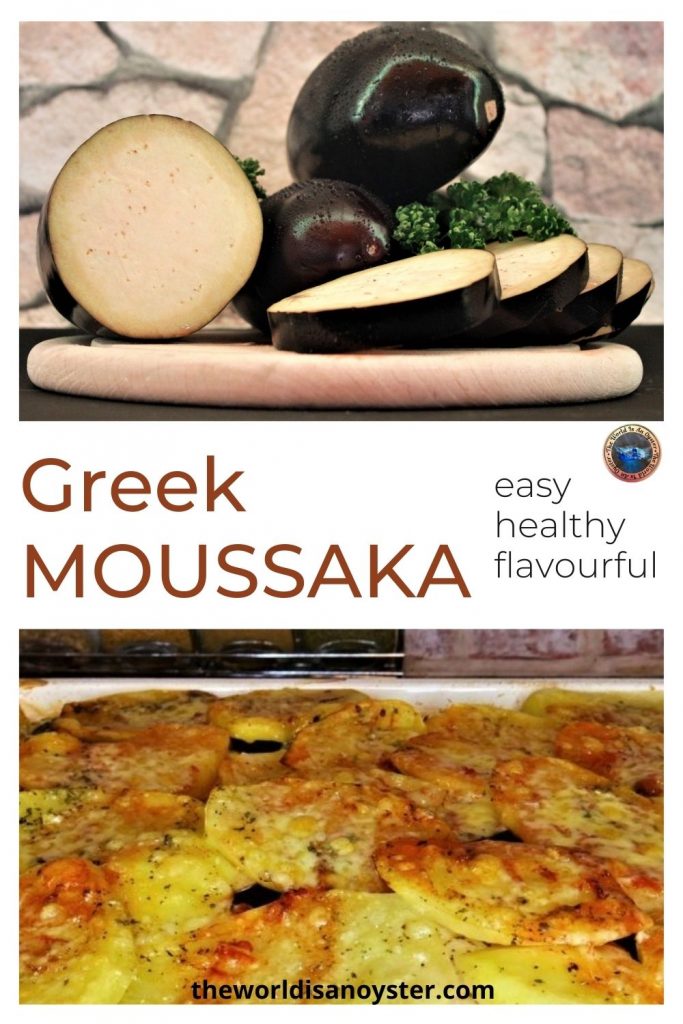
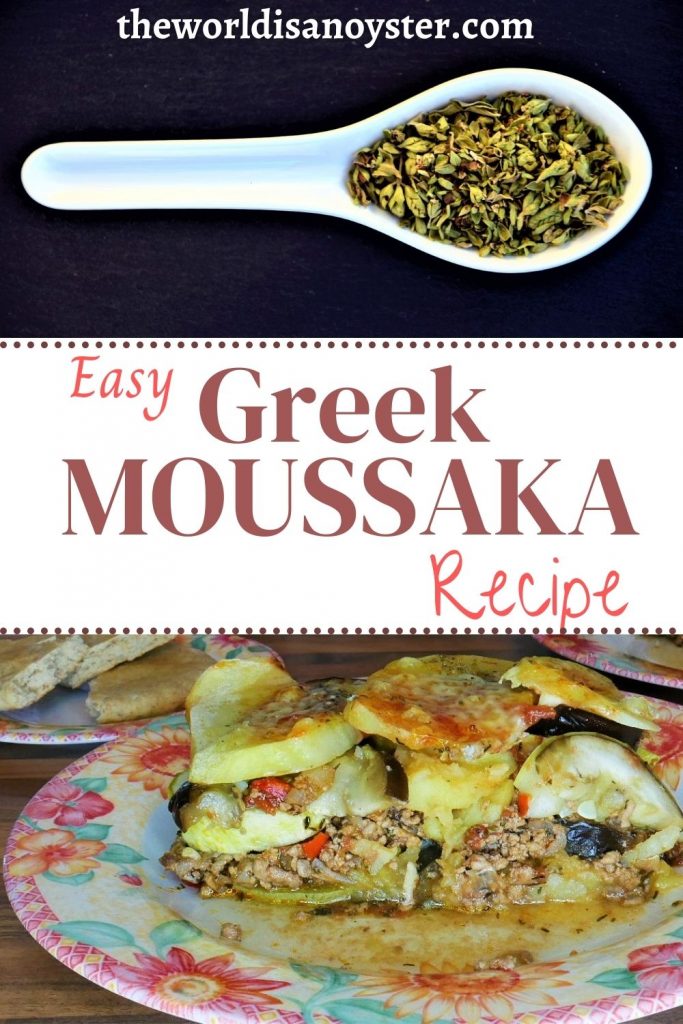
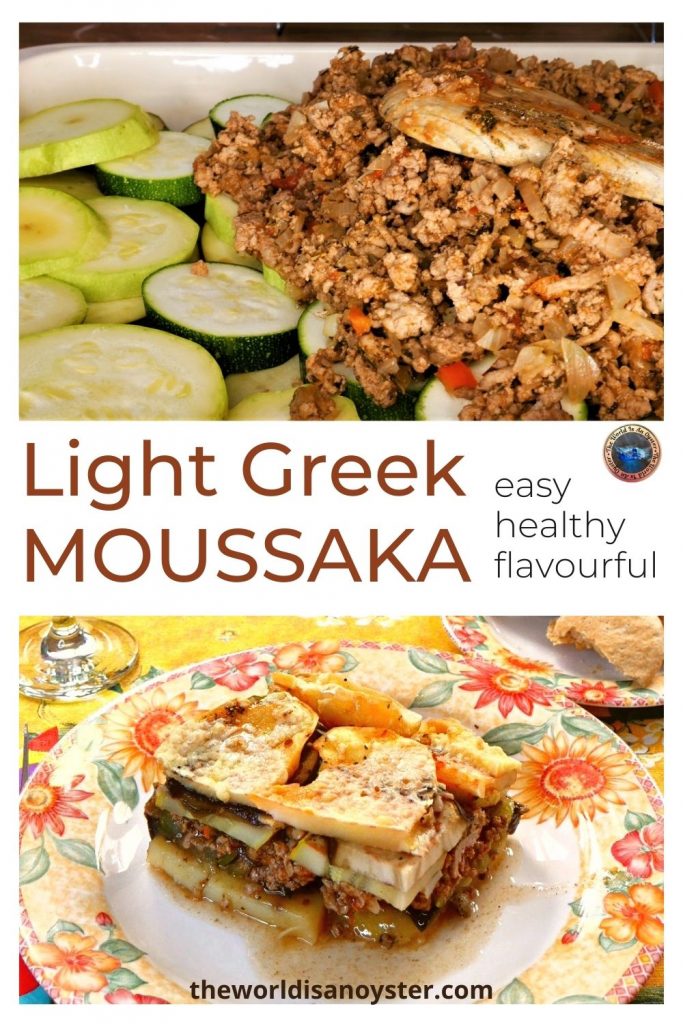
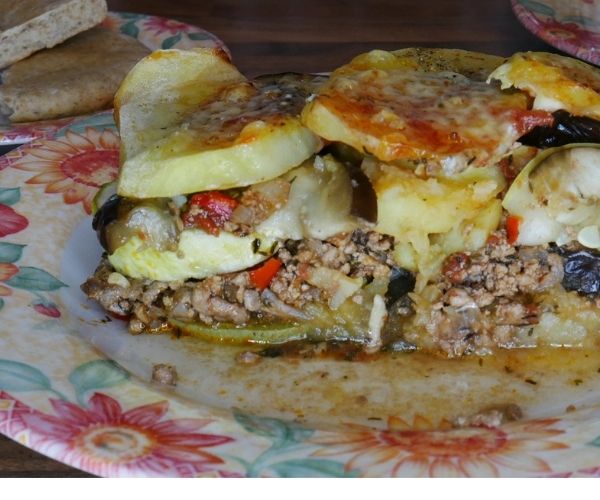
Greek Moussaka
Ingredients
- 2.5 kg potatoes
- 800 g minced beef lean
- 1 pcs pepper sweet pointed
- 4 pcs tomatoes large, or a tin of chopped tomatoes
- 2 pcs onion large
- 2 pcs aubergine large
- 2 pcs courgette
- 6 cloves garlic
- 1 tsp spices (dried oregano, thyme, ground black pepper, freshly ground nutmeg) each
- 1 tbsp rock/sea salt
For the Béchamel Sauce
- 1 l milk full fat
- 100 g butter
- 100 g plain flour
- 100 g Parmesan cheese grated
- 2 pcs egg yolk for colour
- 1 tsp nutmeg freshly ground
- 1 tsp white pepper ground
- ½ tsp rock/sea salt
Instructions
How to Make Greek Moussaka
- Preheat the oven (180°C/350°F/gas mark 4)
- Place the mince in a large pan over medium heat, add a large glass of wine, the finely chopped onions, pepper and tomatoes and stir. Cook it for about ten minutes, stirring occasionally.
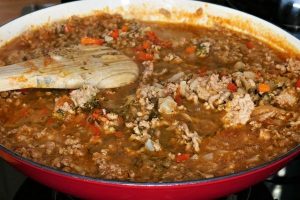
- When it is nearly ready, add the chopped garlic. I always cut garlic with a ceramic knife because stainless steel can oxidise it.
- Add the spices and stir for 3-5 minutes, then turn the heat off.
- For the veggies, you have three options: fry them in oil (they will absorb it like a sponge!), bake them in the oven for 15-20 minutes, or use them raw.
- Regardless of your chosen method, cut the potatoes, aubergines and courgettes in no thicker than one cm slices. Soak the potatoes in cold water for a few minutes (to get rid of the excess starch)
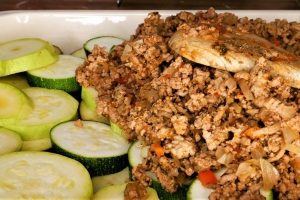
- In a large baking tray, start with a layer of potatoes (sprinkle a little salt and dried oregano). Continue with a layer of aubergines and courgette (slightly salted).
- The next layer is the prepared meat (add half of the béchamel sauce and mix well if you decided to go for it).
- Continue with another layer of courgette, aubergines and potatoes, slightly salted.
- Sprinkle a little dried oregano over this last layer of potatoes.
- To avoid burning the potatoes, I usually spread a couple of tomato sauce spoonfuls over the last layer before baking it. If you made your béchamel sauce, lay the remains of it evenly over the entire surface.
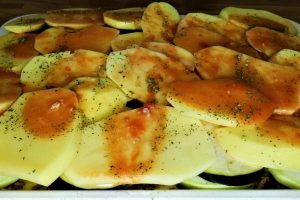
- Bake for 50-55 minutes.
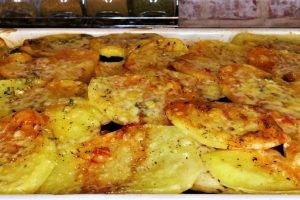
- Just before the time is up, grate some hard cheese on top and bake the moussaka for another 2-3 minutes or until the cheese starts bubbling.
How to Make the Béchamel Sauce
- Warm the milk in a pan over medium heat. The milk should not boil, but it has to be quite hot.
- In another saucepan, melt the butter without boiling it, over low heat.
- Remove the pan from the heat and pour the flour while whisking vigorously with a stainless-steel whisker. It might look lumpy at first, but continue mixing and the lumps should dissolve.
- Return the pan to low heat, and add the hot milk gradually, whisking continuously.
- Add the spices (salt, ground white pepper, grated nutmeg) and stir continuously for about five minutes or until it starts bubbling.
- Remove from the heat to add the egg yolks one at a time, mixing well. Return to the heat for another minute, stirring continuously.
- Add the cheese and whisk for another minute or two, then turn the heat off.
Notes
a bit challenging to place on a plate in one piece (it will not be as glued). Moussaka goes well served with a Greek salad or a simple salad and pitta bread. Enjoy
with a glass of chilled Retsina, my favourite Greek wine! When it is completely cooled, moussaka can be kept in the fridge for up to three days and reheated in the oven before use or frozen for up to 2-3 months. For a vegetarian version, mushrooms are a great substitute for minced beef. Bon appetite!
A Greek Dish With International Influences
The post How to Make Light Greek Moussaka appeared first on The World Is an Oyster.
]]>The post Traditional Greek Salad: Healthy, Nutritious and Easy to Make appeared first on The World Is an Oyster.
]]>A Gastronomic Tribute to Homer’s Mythical Heroes and Feta Cheese
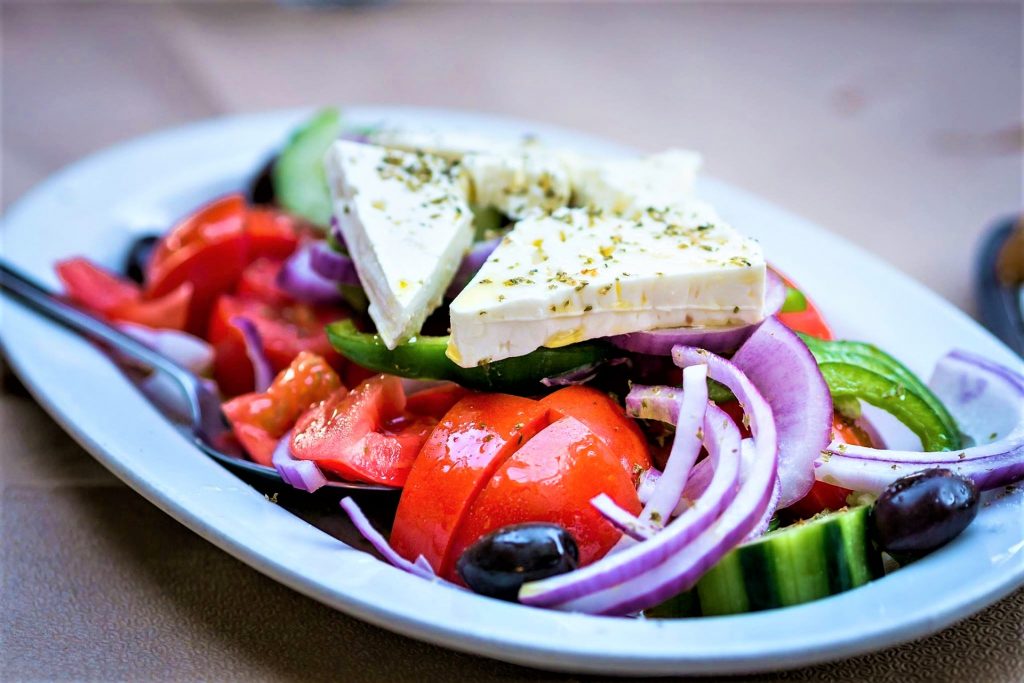
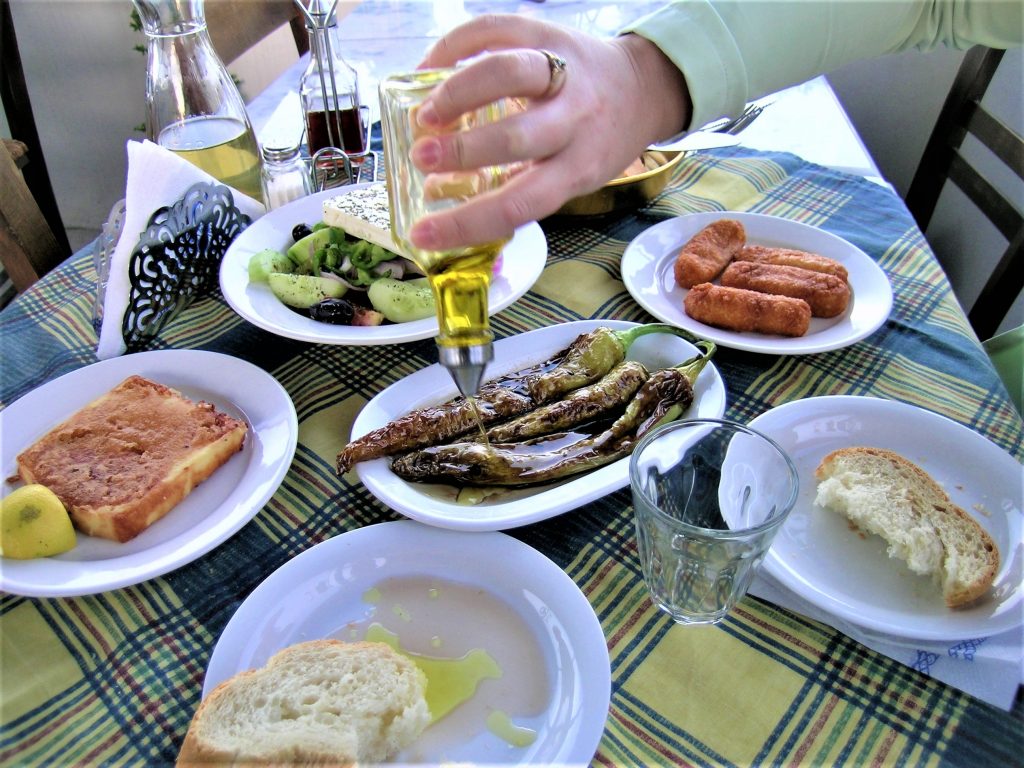
It is impossible to visit any part of Greece without eating at least one traditional Greek Salad. I’ve had my fill almost everywhere, but I liked it better in Santorini. Not because the recipe was any different, but because the company was excellent!
I was spending one afternoon idling around the streets of Santorini with my then my boyfriend Hotass (not his real name, just a nickname he acquired on a funny occurrence!)
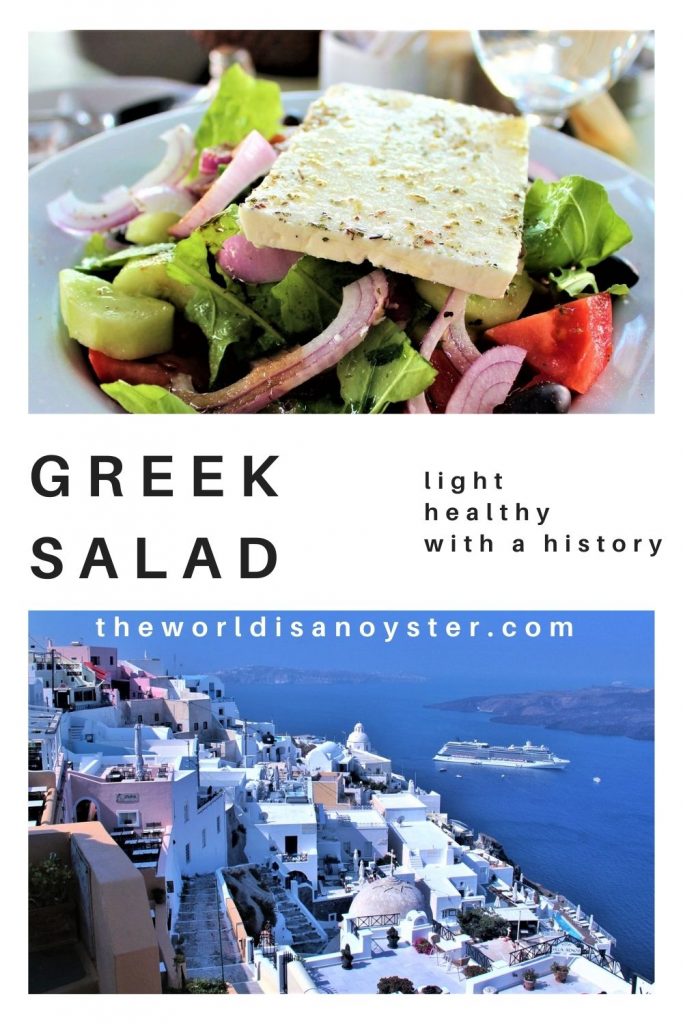
We stopped at a tavern for dinner in the evening while admiring a fabulous Mediterranean sunset over the Santorini Caldera. An exquisite view from a considerable height and the remainder of a massive volcanic eruption that shaped this circular archipelago.

While mulling over the possibility that the said eruption might have sent the famous Atlantis to the bottom of the sea, Hotass admitted that he had no idea about Greek foods, so it was down to me to order what I thought was worth experiencing for the first time. A virgin to moussaka and tzatziki, my American born and bred boyfriend licked his fingers after each course and proclaimed the Greek cuisine divine!
The truth is, you can’t go wrong with things that many people grow in their gardens. And you don’t have to physically be in Greece (even if it is preferable, being a holiday hot spot for all the right reasons!) to make a simple, filling, healthy and delicious starter or side dish such as this traditional Greek salad.
For me, it turned countless times in a whole meal, especially in the summer months when I go for anything light, healthy and easy to make.
Before you start preparing your Greek salad, here are a few things that could help you understand why the Mediterranean diet is regarded as one of the healthiest ones.
Feta cheese facts:
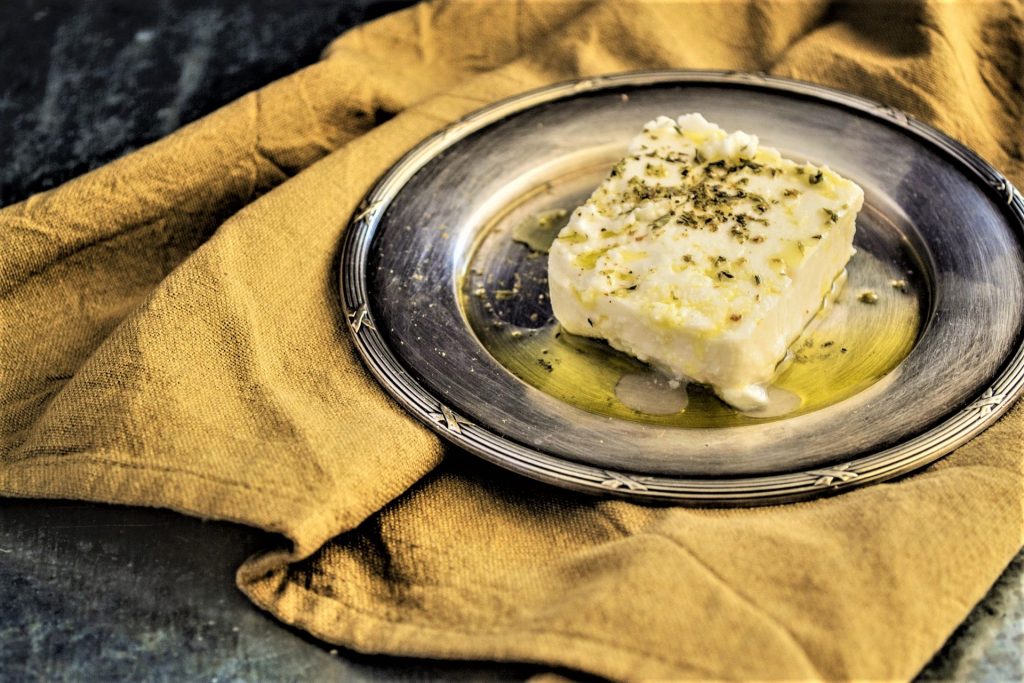
- It was first prepared over six thousand years ago, allegedly by a mythological cyclops named Polyphemus in Homer’s Odyssey.
- The original name was tyripheta, the Greek for a slice of cheese. The current name comes from the Italian fetta that translates as a slice.
- It is made of goat milk (30%) and sheep milk (70%), explaining the sharp taste.
Kalamata olives facts:
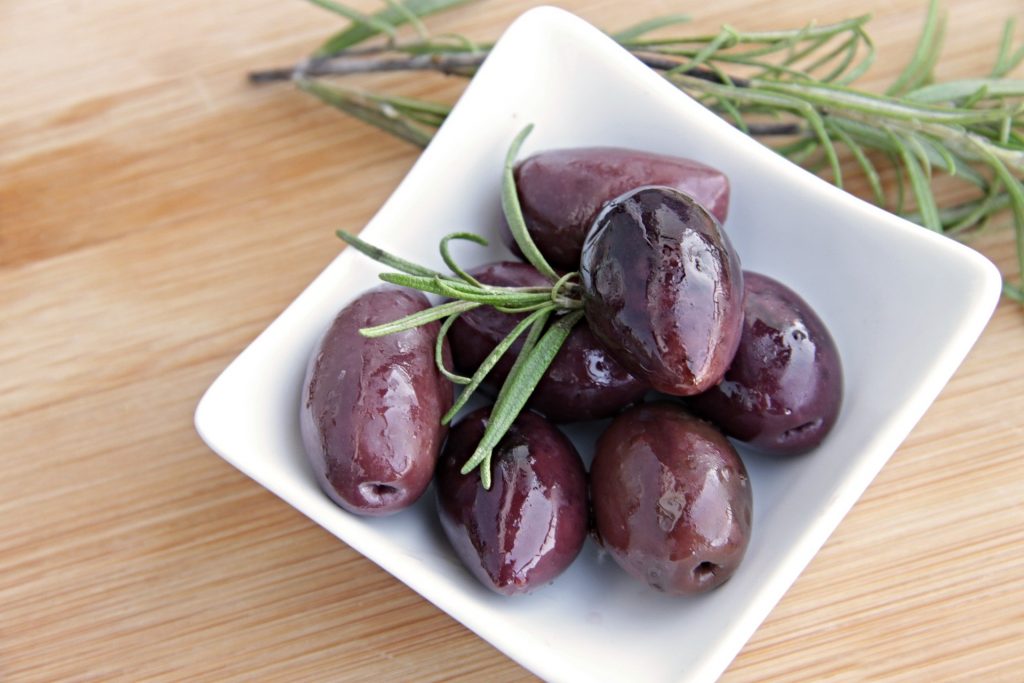
- Are cultivated in the coastal city with the same name, two and a half hours driving from the Greek capital, Athens.
- Are rich in antioxidants that prevent the free radicals from damaging the cells in your body, reducing chronic disease risk (cardiovascular, cancer).
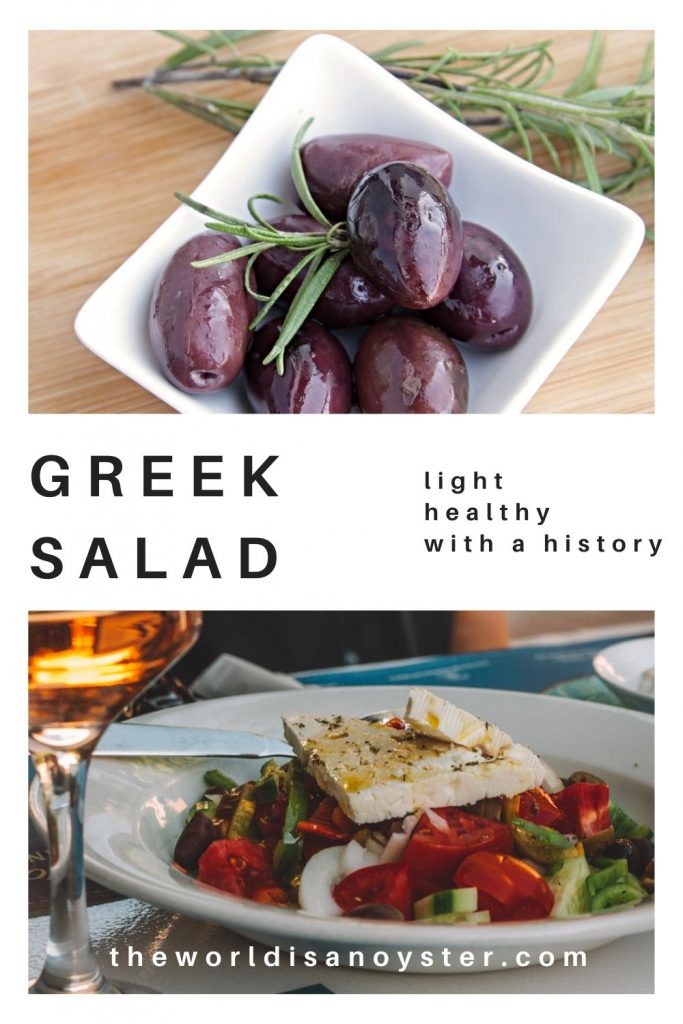
- An antioxidant called oleuropein (that fights bacteria and some viruses in your body) gives the slightly bitter taste.
- Oleuropein together with hydroxytyrosol (also found in Kalamata olives), reduces the inflammation level in your body, fights against the effect of the UV, and reduces the risk of Parkinson’s or Alzheimer’s.
- Are rich in vitamins B, C, E and K, which benefit your heart health and eyesight.
- Are packed with minerals such as copper, potassium, calcium (good for your bones), iron (keeps anaemia away), phosphor and magnesium, all helping to reduce the risk of cardiovascular disease.
- Contain a high percentage (75%) of monounsaturated fats, mainly oleic acid, good for your heart.
- Contain a lot of water and have a nutritional value: 230 kcal, 13g carbohydrates, 7g fibres, 17g fats and 2.3g sodium per 100g olives.
The latter is also the maximum daily salt intake recommended for an adult. Keep in mind that the feta cheese is salty too, and with just one (healthy!) meal, you can easily exceed the suggested limit. Moderation is key!
Ingredients for Traditional Greek Salad:
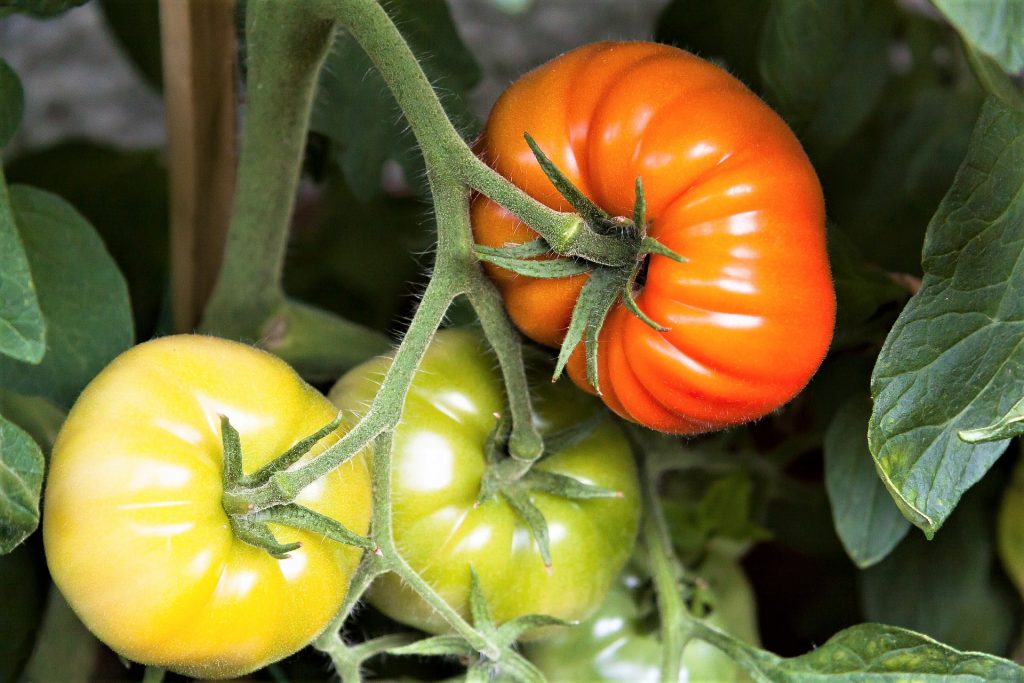
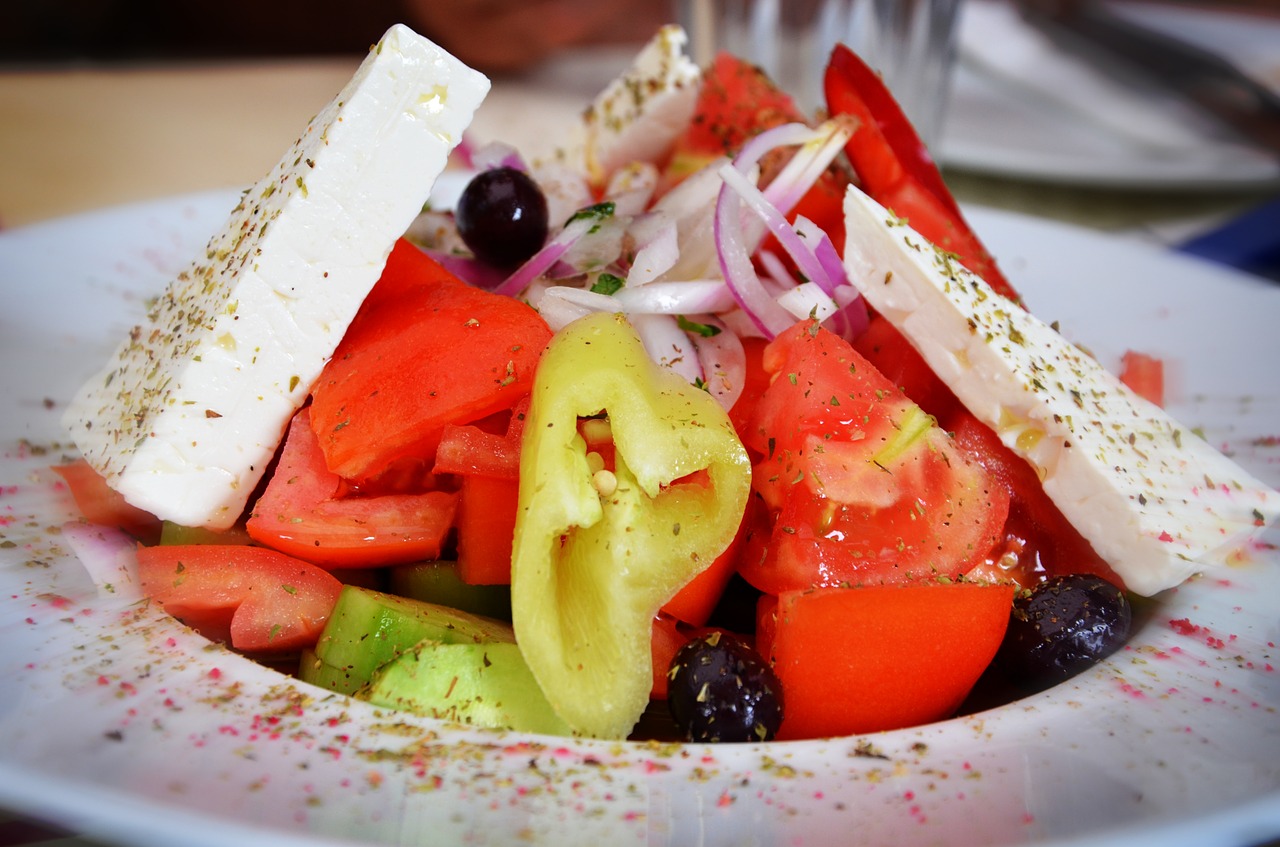
Chunky tomatoes
Gherkins
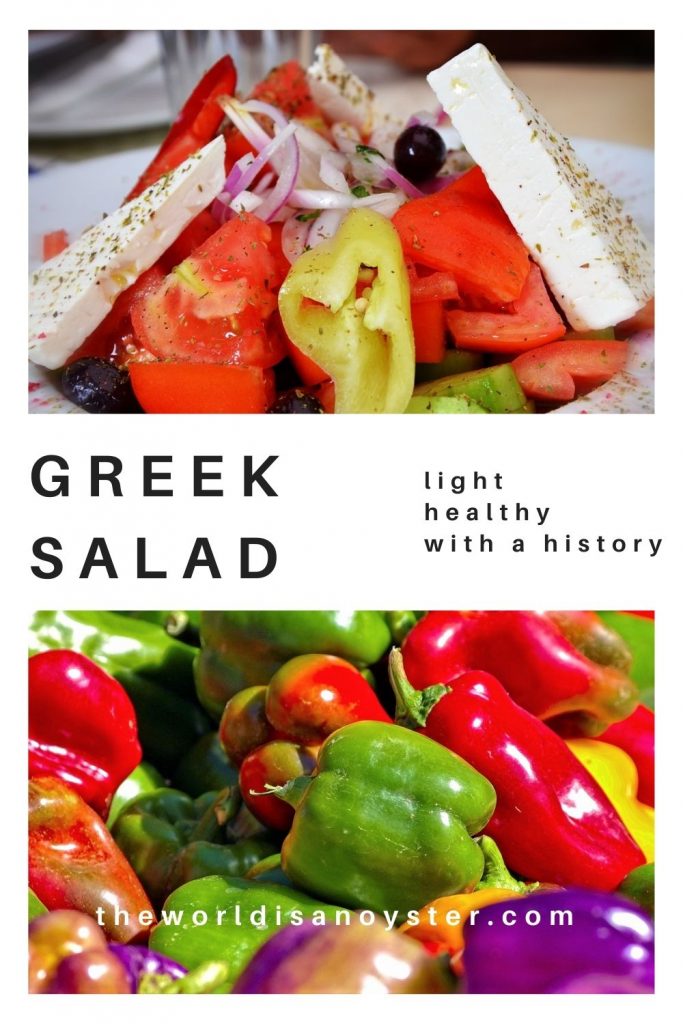
Bell pepper (any colour)
Red onion
A few Kalamata olives
Two slices of feta cheese (a pack has typically 200g, enough for two portions)
Three tablespoons of a quality Greek extra virgin olive oil
A sprinkle of dried oregano
A dash of ground pepper
A tiny bit of salt (there is plenty in cheese and olives!)
How to make Greek Salad:
It is not exactly rocket science. Just wash and dry the veggies, slices them, add the olives and place them all in a large bowl. Add the salt, pepper and a little olive oil and mix.
Fill two plates with the veggies, then place the slices of cheese on top, sprinkle the oregano, pepper and the rest of the olive oil, and that’s it. Your salad is ready! Colourful, healthy and I’m drooling! I’m off to the kitchen; I have just sorted my dinner! What about you?
Bon appetite or, as the Greeks would say, Καλή όρεξη [Kalí órexi]!
Traditional Greek Salad
Equipment
- Mixing bowl
- Chopping board
- Salad mixing spoon
- Serving dishes
Ingredients
- 2 tomatoes organic, large
- 1 bell pepper organic, any colour
- 2 gherkins organic
- 1 red onion organic
- 1 handful Kalamata olives
- 2 slices Feta cheese
- 3 tbsp olive oil extra virgin, organic
- 1 tsp dried oregano organic
- 1/4 tsp rock/sea salt
- 1 dash ground pepper black
Instructions
- Wash the vegetables, dry and slice them on a chopping board.
- Place the chopped vegetables in a large mixing bowl, add the Kalamata olives with a dash of olive oil and mix gently with a large salad spoon.
- Divide the salad mix and fill two serving dishes.
- Place a slice of Feta cheese over the vegetables.
- Sprinkle the remainder of olive oil, dried oregano and pepper on top.
- Serve cool as an appetizer or side dish for Moussaka or other meaty Greek dishes.
I hope you enjoyed reading this recipe and the little history! Would you mind sharing the love by saving a pin to your dinner boards? Thank you!
A Gastronomic Tribute to Homer’s Mythical Heroes and Feta Cheese
The post Traditional Greek Salad: Healthy, Nutritious and Easy to Make appeared first on The World Is an Oyster.
]]>The post Rhodes, Greece. Love in the Times of Ancient Civilisations appeared first on The World Is an Oyster.
]]>Colossus. Glory And Oblivion
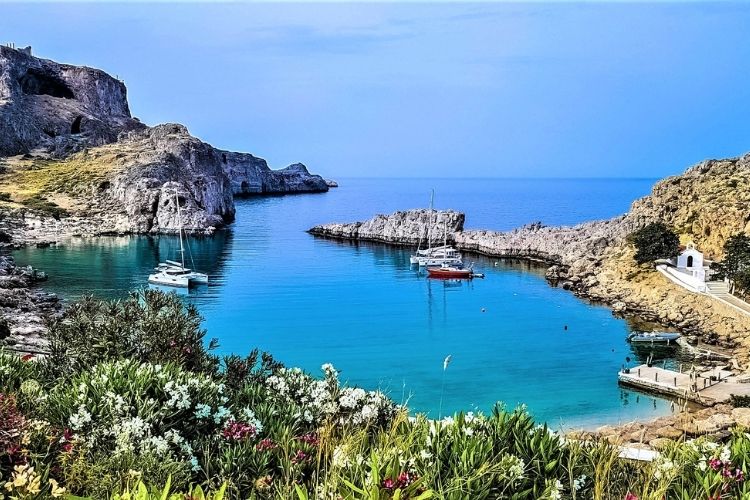
Music: Amaranthine, Amaranthe
Movie: Colossus of Rhodes, a Sergio Leone classic
Book: The King Must Die, Mary Renault
This post may contain affiliate links, which means I will receive a commission if you purchase through my links at no extra cost to you. Please read the full disclosure for more information. Thank you!
Rhodes, 226 BC
“Ebele, come greet Croesus! He has come to arrange the transport for the archon’s order!”
“Mother, I’m busy now. Tell Croesus I’ll speak with him later!”
Ebele rushed to the pot of stale water to rinse her hands of clay before checking the kiln.
Dry clay covered her bare arms to the elbow. Her delicate face was also smeared in places. Many a time, Ebele would rub her forehead to wipe the sweat without even thinking that she was elbow deep in wet clay.
Her dark strands were just as messy, no matter how much care she took to tie it in a knot in the morning. The tresses will always rebel out of the knot and touch the wheel or some fresh pot.
The original colour of her peplos was a thing of the past. In less than a week, any clothing would become a strange splotch of clay and paint.
She worked from dusk to dawn in the small backyard in merciless swelter and next to the kiln. To add to the day’s warmth, the beast spewed heat like a volcano every time she opened the door to stow a pot in or to take one out.
Ebele discovered pottery the day her father took her on his knees for the first time and held her tiny hands around a damp mould of clay. As the table trundled, the mould became an amphora with a long neck under the little child’s astounded eyes. Then, in a second, it fell right down in a messy pile as she jumped off her father’s knees.
Everything occurred so quickly that Ebele had no time to process what had just happened. She was excited to show her mother her miraculous creation when suddenly there was none.
Ebele cried, but her father dried her tears with his splotched hands. The man patiently explained to the little girl that pottery meant trial and error. She would ruin many amphoras before she would drink fresh water from one made by her hands. The tears dried on the little girl’s face. So did the clay. Since that day, she was rarely smudge-free.
Ebele was barely five when she had her first try at pottery. She remembered her father’s smile and patience with her. She remembered how in the years that ensued she would sneak in the courtyard at night when the house was sleeping and wheel any leftover clay from the man’s workday.
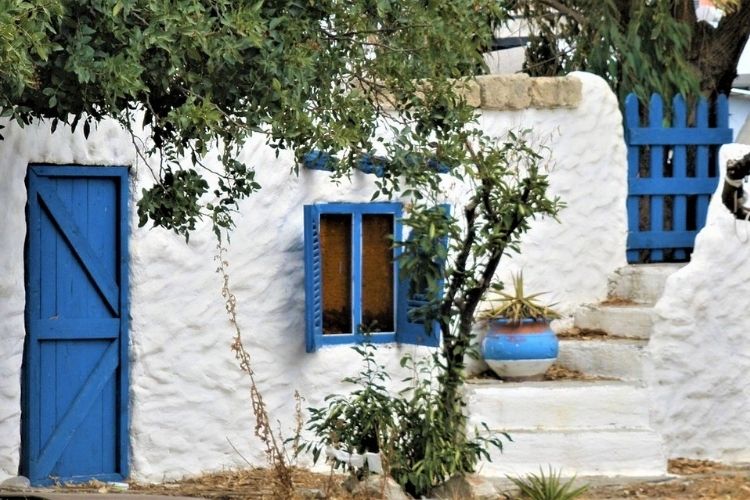
The pottery shop was her father’s business. The pots he made were always in high demand, and the fame of his designs had reached many places outside Rhodes. His primary clients were the merchants that had flourishing export business with the island of Ledra and farther east, all the way to Phoenicia.
Phoenicia! Ebele left a sigh to escape her mouth while sweating blood at the kiln’s dragon mouth. Four large amphoras and seven smaller jugs were dry enough for the next step in her trade: painting. She removed them carefully from the kiln using a large shovel and placed them orderly on a shelf to cool down.
As her hands kept busy, her thoughts trailed back to her recent past.
Twelve years after her father introduced her to the magic of pottery, the kind man departed from this world, overwhelmed by incessant work to cover his orders and a cough that racked him for months. Ebele found herself alone with her mother and orders that were piling up.
In the past year, all she has done was work from the first ray of dawn until late at night. In the coolness of the dusk, she would squint her eyes while painting the vases with a steady hand.
For light, she would use tallow lamps that came out of her skilled hands and were flickering in each empty corner of the courtyard.
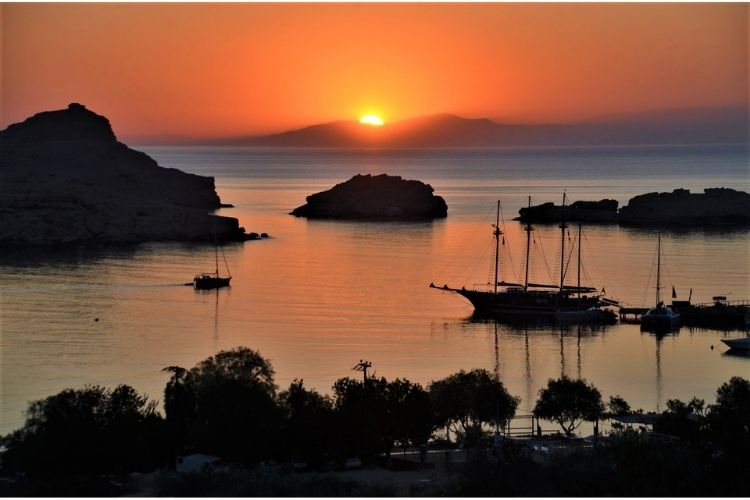
Her throat was always sore, her eyes dry, and her body numbed by the endless hours she spent bent over each pot. But no amphora left the tiny courtyard without an intricate design carefully painted on.
Since Ebele found an urn buried in the vineyard at the back of the house that belonged to her great-grandfather, Chares of Lindos, she fell in love with the older styles. She started using more often black and orange to paint her pots.
In a short time, she realized that the black figures looked much better on an orange background and that these specific colours were way more resistant to the tongues of fire in her kiln.

Besides, the urn she’d found must have spent about a century buried in the ground and yet displayed the most vivid colours as if Chares had only painted it yesterday. Alas, the great architect who built the Colossus statue at Rhodes pier’s mouth had been dead and buried an eternity ago.
That was ancient history she learned as a little girl. It was her family’s heritage. Each generation after the great Chares made sure the sculptor’s most significant accomplishment would be kept alive.
Many a time, as the family gathered around the dinner table, Ebele’s father would tell how the gigantic statue came to being.
And each time, the wide-eyed listener was sworn to secrecy. The mystery of such an outstanding achievement was carefully preserved in her household.

Ebele was holding a belly amphora on her lap, her thin brush dripping with ochre she liked to use for painting the clothing of the people who adorned her pots. She blinked as a drop of red got in her eyes. When she could see again, she looked down.
Great! A splotch of red pain was now smearing her peplos. By the gods, what a mess she was! She realized that she desperately needed a new one. It was an excellent time to take a little break and visit the market in port. And maybe see what business Croesus had with her, other than checking the order she was still working on.
She would need to grow another pair of hands to work faster. Of course, she had enough coin to afford to hire an apprentice and teach him the trade. But it would require time she did not have. Besides, no apprentice will ever paint like her. That was something she could not teach. It was an innate gift, and she knew she was more than gifted with the brush.
Her passion was her downfall as well. The merchants were queuing at her mother’s door to place orders for the beautiful urns. The old-style colours made the trade all the more attractive and soared the profits. From Rhodes, her long neck or belly amphoras filled with grains or spices were shipped as far as Carthage in the west or Phoenicia in the east.
Phoenicia! Another sigh escaped her mouth. Every time she was starting to form a thought about it, some mundane action required her attention. Nonetheless, the idea was always at the back of her head.
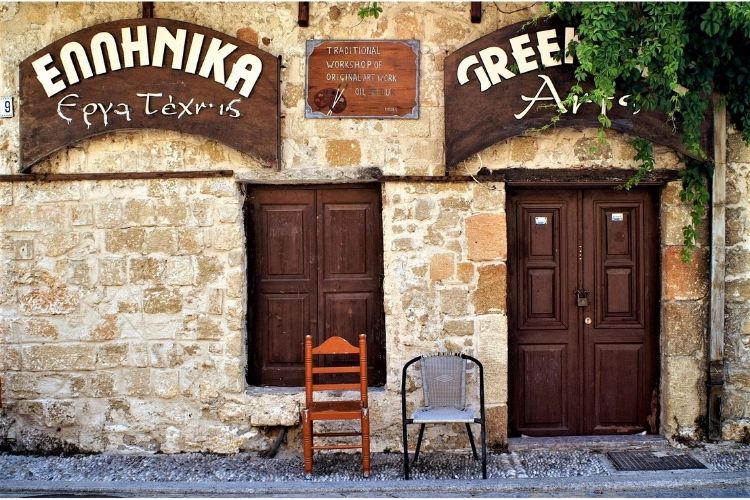
Her mother was a Phoenician, but Ebele, born and raised in Rhodes, has never visited her mother’s side of the family. She knew she had an uncle and cousins in Byblos but never had a chance to meet them in person. Since the business was booming and money was pouring in, she thought she would allow a more extended break and take her mother to visit her homeland and estranged family. Perhaps even selling the business and moving to the mainland would not be a bad idea at all.
Ebele loved Rhodes, but it was just an island always at the whims of a conqueror or another. It is true that since the last occupation of Alexander from Macedonia a century ago, nobody else could break the walls and invade la land. It does not mean that they never tried.
Thank the gods, all the foreign ships that docked in port these days were sailing to Rhodes for trade, not war, and for wondering at the magnificence of her great-grandfather’s Colossus. But still, a more severe attack would mean serious hardship for two women with no one to protect them or the business.
Ebele thought that her uncle in Byblos would provide more protection and comfort. And if anything were to change overnight, her mother and herself could always take refuge farther inland. There was nowhere to hide from soldiers in Rhodes, except for the caves that linked her village to the port.
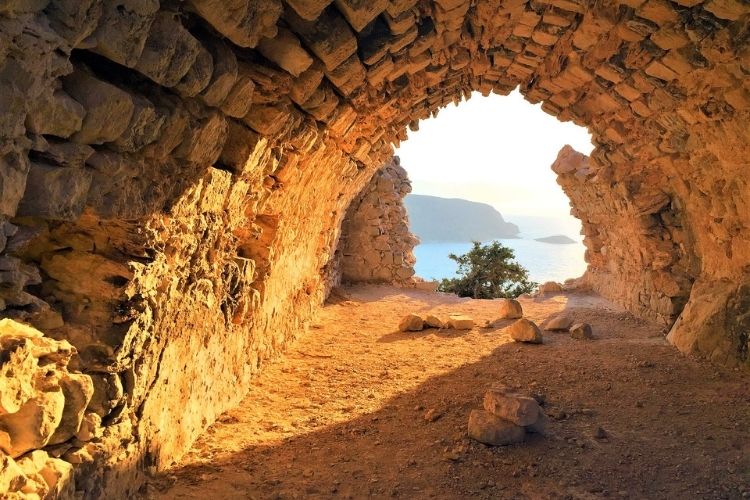
The limestone caverns were only familiar to the locals. As a child, Ebele used to explore them while playing with the other children in the village.
A thought started to form in her mind. Perhaps she should take the path that led to the cave entrance instead of the busy road to the town. She could get to the port using the underground passage. Maybe it was worth checking if she could still find her bearings and see if the escape route to the port was still clear.
As soon as the idyllic scene of young shepherds peacefully watching their flock was ready and started to dry on the belly amphora, Ebele, content with her design quality, went looking for her mother. The good woman would be happy to know that her hard-working daughter decided to take the afternoon off and go to the market.
“Thank the gods, daughter of mine! It’s about time you look presentable. What would our neighbours think if they saw you at this moment? I cannot even fathom it! You look worse than a beggar and dirtier than one! Go and give yourself a thorough scrub before you step out of my house!”
Ebele giggled happily and hugged her mom. As expected, that produced another wave of lamenting from the good woman as she wiped the red smear the daughter’s embrace has left on her cheek.
It was all happy banter. The two souls left alone in the world would treasure such rare moments of contentment.
Ebele, a Phoenician name that meant compassion, was more precious to her mother than life itself. It pained the good woman that the only child she had was working so hard to procure for both of them. What fate would this wonderful girl have? Would she find a husband to treat her right and protect her?
Ebele was a wild spirit, an artist who needed to be free, not enslaved in the wrong matrimony or worse, at the whims of someone in power. The mother watched the daughter as she disappeared into the house to clean the clay and paint off, cheerful giggles still trailing behind her.
The woman sighed deeply, concerned about her daughter’s future. Why has Croesus demanded to see her earlier? And why has he accepted her dismissal without much fuss? Perhaps the business he had with Ebele was somebody else’s, and the soldier was just the carrier of a message he was not happy to convey. He seemed a good man, but he was only a guard in the archon’s employ. And the archon was Rhodes’ most powerful person.
The woman shook the worrisome thoughts off and went about her business around the house.
Ebele emerged fresh and radiant, a charming smile brightening her face like the God Apollo a summer’s day. How beautiful she was when she let her ebony curly locks free on her shoulders!
“Don’t stay too long and buy some food for supper as well. Spare me a journey to the market since you’re going anyway!” Shouted her mother from the door frame.
“I won’t! And I will!” Ebele’s answer echoed from the road.
Her mother has seen the small, tallow lamp the girl was doing such a lousy job at trying to hide in the folds of her clean peplos. If only she won’t get in trouble!
In less than an hour, Ebele was in the bubbling market. She offered the lamp to an older woman selling vegetables and remembered to buy some greens for tonight’s supper.
She could quickly become distracted and forgetful when her mind was busy churning, which happened all the time.
The way through the caverns was precisely how she remembered it from years ago. A couple of times she was about to take a wrong turn, but she looked for the tiny stick man carved in limestone and familiar only to those who truly knew their way through the dark chambers.
One thing solved. Supper supplies are sorted as well. Ebele looked around for a clothing stall and quickly bought a peplos without much fuss. Giggling, the young woman dismissed the merchant who seemed somehow offended by her lack of interest in his array of fabrics and colours.
Ebele was practical. What was the point of picking? By tomorrow evening, the new dress will be splotched with paint and smudged with dry clay.
Shopping done, Ebele decided to take the usual road back to her village. That meant to pass by the castle. Even better! Croesus should be on duty and tell her why he wanted to see her earlier.
Before she even finished the thought, a firm hand pulled her arm and dragged her on a quiet alley. A rough hand covered her mouth to prevent her from screaming. She was not going to. Everything happened so quickly, Ebele didn’t even have time to react.
To her relief, though, the man who grabbed her so abruptly was Croesus.
“Apologies, Ebele, I did not mean to frighten you, but I do need to speak with you urgently!”
“You scared me and bruised my arm!” Ebele snapped, startled. She rubbed the red mark, thinking that she might find it difficult to lift the bigger vases tomorrow. “What is so urgent, then?”
“The archon likes your amphorae …”
“Yes, I know”, Ebele cut Croesus short, a tad annoyed. “I am quite busy working on a large order for him. The one you placed, remember?”
“Yes”, Croesus sighed deeply. “But has it ever occurred to you that he might have further reason to place this order?”
Ebele felt the hairs at the top of her head rising. The fact that the archon was the wealthiest and most powerful man on the island was well known. How he found pleasure in exercising this power in all aspects of life on the island was also known and feared by most, especially by young girls.
The archon has made a habit of inviting the most beautiful ones to visit him at the palace. Refusal meant their families were brought to ruin and castaway in the farther corners of the island to live a lifetime of misery.
Many fathers found themselves in the impossible conundrum. And many young women ended up in the palace for a while, until the old satrap would get bored with them and look for younger ones.
“Yes”, continued Croesus observing the change in Ebele’s pose. “He asked about the artist who painted such fine vases. His weasel of a counsellor was extremely informative in his desire to please his master.”
“Croesus!” Ebele screeched, forgetting that they were still close to the bustling market and could attract unwanted attention. “You cannot take me to the palace. I will not go!”
“Trust me, it is the last thing I would want to do! But you should try to hide somewhere, for a while at least, until he loses interest.”
“Hide? Where? Rhodes is only an island, and everybody here knows me. After all, I am the great-granddaughter of Chares of Lindos!”
Ebele automatically turned her head towards the gigantic statue wearing a crown of rays on his head that guarded the entrance to the port.
“I have his Colossus to thank that for!”
“True!” Croesus was visibly preoccupied. “But listen, isn’t your mother Phoenician”?
“Yes, she is. I have an uncle and cousins in Byblos.”
“That could work, then.” His mind was churning, trying to find a solution to this quandary. No way would he allow to see Ebele walking the shiny marbles of the palace to the archon’s private chambers! It would be his ruin. She was the first woman he ever liked, truly liked.
“There is a boat in port that is due to sail to Tyre tomorrow. I can get free passage for you and your mother. Then you will have to find a way to travel from Tyre to your uncle in Byblos without attracting too much attention. I hope this will work. Anything is better than seeing you at the whims of the governor!”
Ebele looked at her hands that seemed like a child’s clasped between his strong, tanned ones. As her eyes lifted slowly to meet his, she saw why he was doing all this for her. At the same time, it struck the young woman that they would never see each other again.
A sting in her heart at the realization brought a profound sense of panic upon her. In a second, her entire world has turned upside-down.
To avoid a destiny many young women were sentenced to, Ebele would have to abandon her late father’s business and her passion, Rhodes and a decent man who clearly had feelings for her. She will go to Phoenicia in exile. All she wanted was to visit her mother’s family!
“Very well, then”, she spoke in a weak voice, “I will go home, tell my mother, grab all we can and be ready for tomorrow.”
“Take my horse and use it for your cart in the morning. Meet me here before the first light; I will be prepared to take you both to the boat. I trust the captain. He will help.”
Ebele straddled the horse, forgetting the greens and her new peplos left behind in a heap on the dirt.
The night was a blur of a rush to gather whatever was necessary for the unprepared trip.
Following Croesus’ advice, the two women left their house before dawn, watching with tears in their eyes how it was rapidly swallowed by darkness.
“At least, we did not have to walk all this way through the caves”, said Ebele absentmindedly. The dark covered the perplexed look her mother threw at her. The way her daughter’s mind worked was an enigma to the good woman.
The market was deserted in the darkness. Small lights were flickering from the boats docked in port. The only noise at the early hour was the hoof clatter of the horse pulling the barely loaded cart.
In the shade of the corner where Croesus pulled her yesterday, Ebele saw a shape moving. It was him. She sighed in relief as the man approached.
“You will have to walk from here. Keep close to the wall, move swiftly and try not to attract the attention of the guards. Follow me closely; I will take you directly to the boat for Tyre!”
He grabbed the larger piece of belongings, grateful that the women did not concern themselves to pack an entire house.
As they walked hastily, keeping in the shadow of the pier’s wall, the water in the bay started to wobble and splatter at their feet. A first, barely perceptible shake of the ground increased by the second until the entire wharf was shaking so violently that it sent the three people tumbling down.
“It’s an earthquake!” Ebele’s mother screamed, terrified.
“Get up!” Shouted Croesus, who was already pulling the old woman’s arm to help her. “You have to board the boat and leave Rhodes immediately; the entire palace will get out in the streets in a moment, and all will be lost!”
Ebele grabbed her bag filled with coins and ran to where the boat was moored.
The moonlight was casting a pale light over the metallic Colossus. Ebele lifted her eyes to the massive structure and saw it trembling dangerously over the port. A deafening metallic creak filled the air above their heads, stopping the three of them dead on their way.
The gigantic statue’s left knee cracked open. The giant gave up his watch and fell with a thunderous noise over the boats moored in port. The Colossus’ ray-crowned head collapsed across the pier, taking it down to the bottom of the sea, together with the three souls that were desperately looking to escape destiny.
Rhodes, August 2011
I opened my eyes as the tour guide announced that the bus was approaching the Rhodes cruise terminal. I had to rub the sleep away and the weird dream.
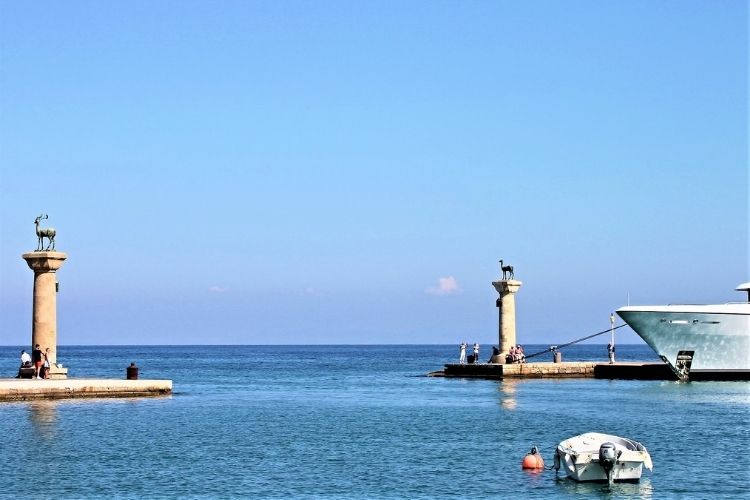
I searched around for any sign of a fallen Colossus. Nothing! The two relatively tall bronze columns that towered at the entrance in Mandraki Port sported on top the two animal symbols of Rhodes: Elafos (stag) and Elafina (doe). Not as imposing as the thirty-three meters tall Colossus, yet stylishly adorning the sea gate.
Behind the cruise ship was moored a luxury yacht, complete with a pool and helipad. The tour guide said that it belonged to Abramovich. A big, flashy thing; everybody turned excitedly to take pictures of it.
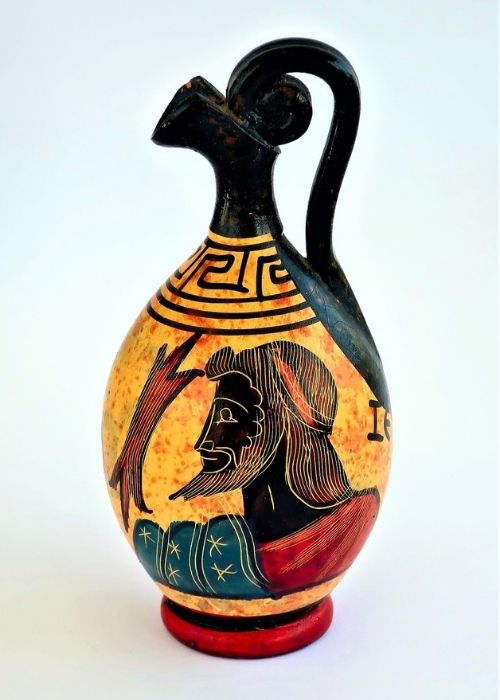
I turned my eyes the other way, trying to make sense of that dream. I removed the wrapping of the amphora I have bought in Lindos and stared at the black and orange paint. It was a beautiful replica of ancient Greek pottery.
I looked out the window again and wondered if a gifted girl of no importance was trying to convey a message across millennia. Maybe she wanted me to know about her ephemeral existence on this planet and her contribution to her artistic era.
I wondered how many of the vases dug up or recovered from the bottom of the sea could have been her work of art. Alas, if she even lived, her name was lost in time immemorial.
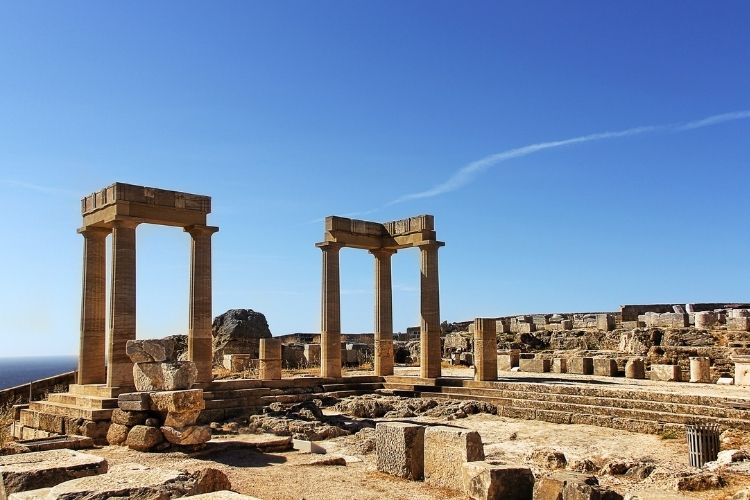
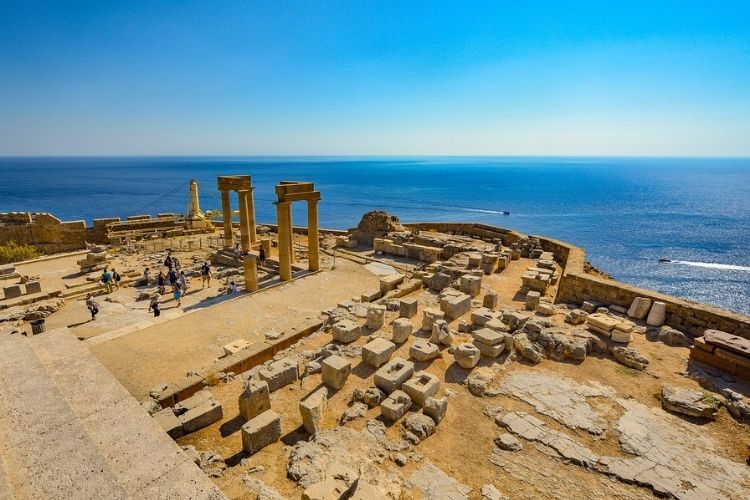
Meanwhile, the Colossus of Rhodes remained alive in humanity’s collective memory as one of the Seven Wonders of the Ancient World together with the Pharos of Alexandria, the Hanging Gardens of Babylon and the Mausoleum at Halicarnassus, all long vanished from the physical world.

I hope you enjoyed reading this story! Please share the love by pinning this to your travel boards; it will help this blog grow and motivate me to write more for your enjoyment! Thank you!
Colossus. Glory And Oblivion
The post Rhodes, Greece. Love in the Times of Ancient Civilisations appeared first on The World Is an Oyster.
]]>